
El Dorado County Court Records After a Jail Arrest
After an arrest in El Dorado County, the booking side and the court side move on different tracks. The El Dorado County Sheriff's Office creates the jail booking record for people held at the El Dorado County Placerville Jail or the El Dorado County South Lake Tahoe Jail. The El Dorado County District Attorney's Office, led by District Attorney Vern Pierson, then reviews law-enforcement reports and decides whether to file a complaint or another charging document in Superior Court. That filed case is the main court record after a jail arrest.
The jail roster can be useful at the beginning because it shows current custody, booking number, arresting agency, booking date, arrest location, total bail, and charge lines. For that custody-side detail, use jail inmate records. For booking-photo questions, use jail mugshots. Court records after an arrest are different. They show the prosecutor's filed charges, hearing dates, disposition, plea or verdict, sentencing order, and court orders. Roster charges can differ from court charges because the prosecutor may amend, reduce, add, or decline charges after reviewing the case.
How to Find El Dorado County Court Records After an Arrest
El Dorado Superior Court directs public users to its Case Index and Department Calendars page and the court's Web Portal for case information. The portal is used for Superior Court of California, County of El Dorado civil, criminal, family law, probate, and traffic matters. The court states that searching case data requires account registration, and it warns that current filings may or may not be in the system. Anyone relying on a hearing date, filing, or case entry should verify it against the court notice or clerk record.
- Open the El Dorado Superior Court Case Index and Department Calendars page and follow the link to the Court Web Portal.
- Register for an account before searching case data. The court's account steps are to click Register, enter the required information, read and agree to the Terms of Use, click Create New Account, and watch for the welcome or activation email, including spam or junk folders.
- Search by case or citation number when available. A defendant or party-name search may be available after login, but the exact post-login search fields were not publicly inspectable without an account.
- Open the matching criminal case and compare the filed charge list with the jail roster's booking charges. Check each charge code, level, status, hearing date, and disposition.
The court's online-services page explains the portal and account requirement. The screenshot below shows the official case-index and department-calendar access point, which is the correct court starting point when a person was booked in jail but the formal criminal case must be checked through Superior Court.
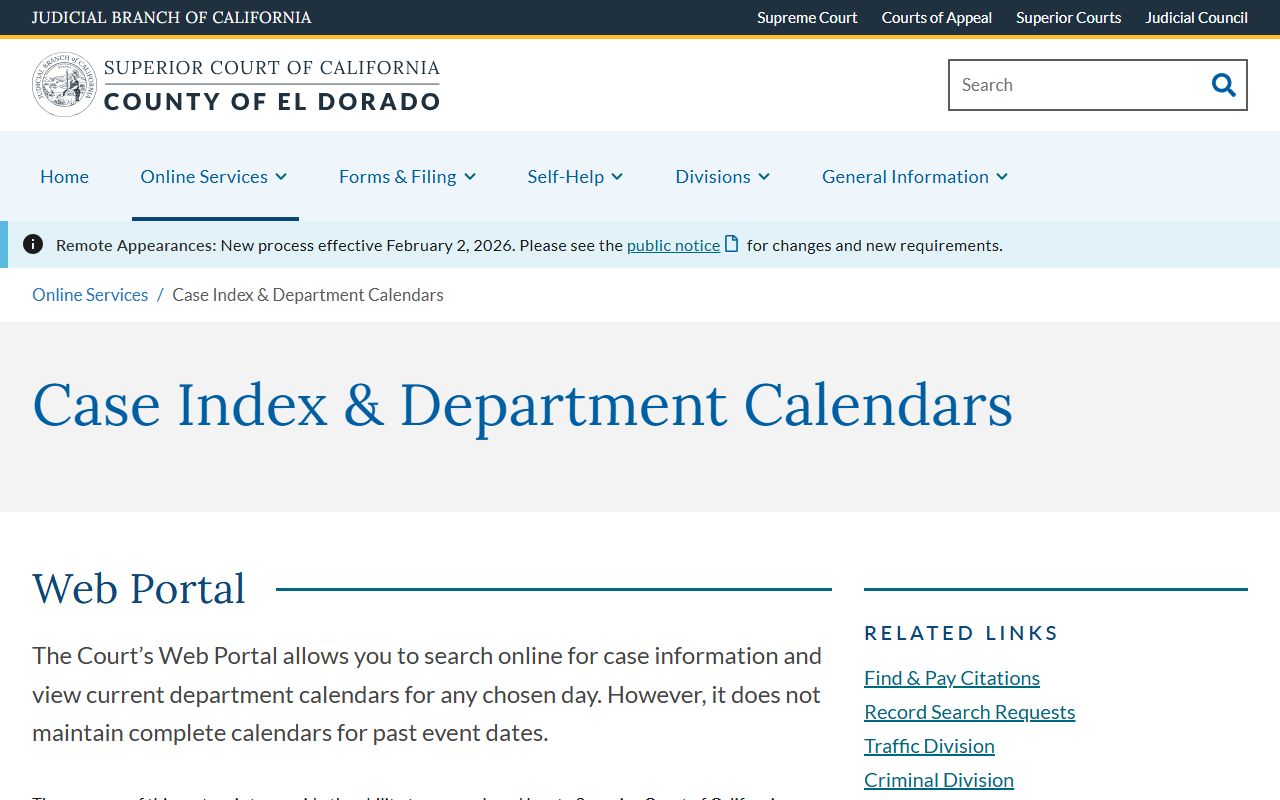
Use the portal for filed charges and court events, not for police reports or jail booking paperwork. If someone is still in custody but no case appears, the DA may not have filed yet, the name may be spelled differently, the matter may be citation-only, or the case may belong in another court. The court record becomes the stronger source for formal charges and disposition once the case is filed.
Court Search and Access Options
The Superior Court portal and the written copy process serve different needs. The portal is the first stop for locating a criminal case, while the record-copy form is the route for certified copies, older files, or documents that are not practical to retrieve online.
| Access Item | Type | Required | Notes |
|---|---|---|---|
| Portal account registration | Login/account | Yes for case-data searches | The court says case-data search requires registration and agreement to the Terms of Use. |
| Case or citation number | Search field | No, but helpful | The portal can locate matters for a particular case or citation number. |
| Party or defendant name | Search field | Helpful | Name search may be available after login; use exact spelling and fewer terms if the first search fails. |
| Department calendar date | Calendar/date | Optional | The portal can show current department calendars for a chosen day; older calendars may be incomplete. |
Requesting Court Record Copies After an Arrest
When the portal is incomplete, unavailable, or not enough for certified documents, use the Superior Court Request for Record Research and Copies form. The form is available for criminal records requested by public agencies, justice partners, and the general public. Requests must be submitted in writing or in person, and payment must be included in advance. Dept. 1, 2, or 7 requests go to 495 Main Street, Placerville, CA 95667, fax (530) 622-9774. Dept. 3 or 4 requests go to 1354 Johnson Boulevard, South Lake Tahoe, CA 96150, fax (530) 542-9102.
| Form Field | How It Helps |
|---|---|
| Requestor name, address, phone, email | Gives the clerk contact and delivery information. |
| Case number or party name | Identifies the court file. Use the case number from the portal when possible. |
| Defendant date of birth | Helps identify criminal records when names are common. |
| File date or years to be searched | Sets the search range if no case number is known. |
| Certified copies requested | Tells the clerk whether certification is needed for an official copy. |
| Document checkboxes | Allows selection of charging documents, disposition, sentencing order, register of actions, entire file excluding unreleasable documents, dismissal order under Penal Code 1203.4, or other records. |
| Fee | Amount | Authority or Note |
|---|---|---|
| Copy fee | $0.50 per page | Government Code 70627(a) |
| Certification | $40 per document | Government Code 70626(a)(4) |
| Offsite file retrieval | $10 | Applies when a file must be retrieved from storage. |
| Rush file retrieval | $40 | Applies when rush retrieval is requested. |
| Search request | $15 | Applies to any search exceeding 10 minutes. |
The clerk's form cannot be used to obtain police reports, arrest reports, incident reports, transcripts, warrants, or confidential documents. Those records route differently. Sheriff booking records and incident reports go through the Sheriff's Records Unit or the arresting agency. Filed complaints, informations, dispositions, sentencing orders, and registers of action go through Superior Court.
How Charges Get Filed After an Arrest: Complaint, Information, and Indictment
The arrest-to-court pathway starts with booking or citation, then prosecutor review. The DA reviews police reports and evidence, then files a complaint in many misdemeanor and felony cases. Felony matters may later proceed by information after a preliminary hearing, and some serious cases may be charged by indictment. The Superior Court opens the case and assigns hearing dates after the charging document is filed.
| Complaint | Information | Indictment | |
|---|---|---|---|
| Filed By | Prosecutor, often after law-enforcement report review | Prosecutor | Grand jury process |
| Common For | Many misdemeanors and initial felony filings | Felonies after preliminary hearing | Serious or grand-jury matters |
| Starts or Advances | Usually starts the criminal court case | Continues felony prosecution after probable-cause review | Starts or replaces a charging path through grand-jury action |
| Where to Request | Superior Court record-copy form, charging-documents box | Superior Court record-copy form, charging-documents box | Superior Court if releasable and filed in the public case |
Charge Status in Court Records After an Arrest
Charge status can change several times after a jail arrest. A booking charge may be based on the arresting agency's initial entry. A filed court charge is the prosecutor's formal accusation. The case record may later show that a charge was amended, reduced, dismissed, resolved by plea, resolved by verdict, or otherwise disposed. Do not treat a current-inmate charge line as a conviction.
| Status | What It Means |
|---|---|
| Pending | The filed case or charge has not reached a final disposition. |
| Amended | The prosecutor changed the charge language, code, allegation, or related filing. |
| Reduced | The charge was lowered to a lesser offense or resolved under a lesser count. |
| Dismissed | The charge or case was terminated by the court or prosecution and is not being pursued in that form. |
| Convicted | A plea or verdict resulted in a finding of guilt on that charge or a related charge. |
| Acquitted | A not-guilty verdict was entered. |
| Disposition | The final or current outcome shown in the court record. |
Bond and Release After an Arrest
The El Dorado current-inmates roster can show total bail for a booking and bailAmount for each charge line. In inspected sample records, total bail ranged from $0 to $50,000, but a $0 bail entry does not always mean the person is immediately releasable. Holds, booking completion, warrants, probation or parole holds, detainers, and court orders can prevent release. The jail roster is custody information, not legal advice or a payment instruction.
| Release or Hold Type | How It Works |
|---|---|
| Cash bail | Money is posted directly if the jail and court confirm bail is currently available and postable. |
| Surety bond | A licensed bail agent or surety may post bond, but licensing and local acceptance should be verified separately. |
| Own recognizance or supervised release | The court may release a person on a promise to appear, sometimes with supervision or conditions. |
| No-bail hold or remand | A court order, detainer, warrant, or agency hold can keep a person in custody even when other charges show a dollar amount. |
Before traveling to post money, call the facility where the person is held: El Dorado County Placerville Jail at (530) 621-6000 or El Dorado County South Lake Tahoe Jail at (530) 573-3030. Ask whether the listed bail is current, whether another hold exists, and what payment methods and hours are accepted. If charges have been filed, confirm bail changes through the court portal or criminal clerk.
Warrants That Lead to an Arrest
El Dorado County does not publish a public warrant-search portal through the inspected Citizen RIMS configuration. Warrants and warrant photos were disabled, and the Sheriff's Records page says staff do not confirm warrants to the public over the phone. For a warrant check for yourself, the Sheriff's public instruction is to appear in person at the Sheriff's Office, jail, or Records Unit with current photo ID, or contact the local court.
A bench warrant may appear through the Superior Court case record because it is a court order. An arrest warrant or fugitive hold can lead to booking at the Placerville or South Lake Tahoe jail, where the current roster may show a charge or hold line if the person is in custody. The roster is not an active warrant database, and the court record-copy form states that the court cannot provide warrants through that copy process.
Charges vs. Convictions
An arrest and filed charge are accusations, not proof of guilt. A conviction requires a plea or verdict. This distinction matters when reading El Dorado County court records after a jail arrest because the public may see a booking entry, a filed complaint, and a later disposition in different systems.
| Charge | Conviction | |
|---|---|---|
| Stage | Accusation filed or listed after arrest | Outcome after plea, verdict, or qualifying disposition |
| Proof Level | Based on arrest review and probable-cause standards | Requires proof beyond a reasonable doubt or a knowing plea |
| Where It Appears | Jail roster and court charging documents | Court disposition, sentencing order, or register of actions |
| Practical Reading | May be amended, reduced, declined, or dismissed | Reflects a resolved finding unless later relief changes public access |
Sealed vs. Expunged Arrest Records
California Penal Code section 851.91 allows a person whose arrest did not result in conviction to petition the court to seal arrest and related records. California also has post-conviction dismissal relief, including Penal Code 1203.4 orders requested through court records when applicable. Sealing, dismissal, and expungement language should not be treated as the same thing.
| Sealed | Expunged or Dismissed Relief | |
|---|---|---|
| Basic Effect | Public access to the arrest and related records may be restricted by court order. | California often uses dismissal relief rather than literal destruction of all records. |
| Common Route | Penal Code 851.91 petition when the arrest did not result in conviction. | Penal Code 1203.4 dismissal order or other relief when eligibility is met. |
| Public Visibility | Portal and clerk access may be limited if sealing is granted. | The case may still have a court history, but the disposition or dismissal order changes how it should be read. |
| Limits | Law enforcement, courts, and authorized agencies may retain limited access. | Relief does not automatically erase every private copy or every agency record. |
Background Check Considerations
Casual public lookup is not the same as a legally compliant background check. California arrest information, court records, and jail roster entries can be incomplete, delayed, sealed, confidential, or corrected after the first public view. Employers, landlords, insurers, lenders, and other regulated decision makers must use appropriate legal channels and cannot rely on a general inmate-population page as a consumer report.
Important: El Dorado County Inmate Population is not a consumer reporting agency and cannot be used for FCRA-covered decisions.
Restricted Court Records After an Arrest in El Dorado County
Public access has limits. Government Code section 7923.610 requires law-enforcement agencies to make contemporaneous arrest information public, including name, physical description, arrest and booking times, arrest location, bail, holding location or release information, and charges, unless disclosure would endanger safety or an investigation. Government Code section 7923.600 preserves exemptions for law-enforcement investigatory and security files. Juvenile records, sealed records, confidential documents, ongoing-investigation material, and some dismissed or restricted matters may not be visible online or releasable by the clerk.
For court records after a jail arrest, use the Superior Court portal first, then the court record-copy form for filed court documents. Use the Sheriff's Records Unit for booking records and police reports, knowing that identification, legal restrictions, and fees may apply. If the subject is no longer in county custody, check whether the person moved to CDCR, federal custody, or immigration custody instead of assuming the court record has disappeared.